
Budget 2026 is an intentional and ambitious one - From manufacturing growth to services supremacy, from technology consumption to AI-powered transformation. This is the blueprint for a $7 trillion economy built on intelligence, not just scale.


India's manufacturing sector growth moderated in August as output and sales rose at slowest rates since January, while competitive pressures and inflation concerns hampered business confidence, a monthly survey said on Monday. The seasonally adjusted HSBC India Manufacturing Purchasing Managers' Index (PMI) stood at 57.5 in August, below July's reading of 58.1 but above its long-run average of 54.0, signalling a substantial improvement in operating conditions.

New Zealand Prime Minister Christopher Luxon on Monday said the negotiations for a free trade agreement with India have been concluded.
'Trump says India will buy over $500 billion of US goods.' 'At present, India's annual imports of goods and energy from the US are under $50 billion.' 'Reaching $500 billion would likely require more than 20 years, suggesting the figure refers to a long-term aspiration rather than a near-term commitment.'

A strong third-quarter (October-December/Q3) performance for 2025-26 (FY26) has helped the stock of India's largest listed pharmaceutical (pharma) company, Sun Pharmaceutical Industries, gain about 7 per cent since the start of February.
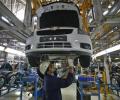
The pace of economic growth in emerging markets continued to revive from the stagnation seen earlier in the year.

'It's harder to attract women initially, but once they come in, retention is significantly higher.'

The Defence Acquisition Council (DAC) has recently approved procurement proposals worth Rs 79,000 crore across three services and it has cleared AoN (Acceptance of Necessity) of Rs 3.3 trillion in financial year 2026 (FY26).

'When a technology is this fundamental, a country should have its own version of it, rather than relying on whether someone else chooses to build it for you.'

Benchmark stock indices Sensex and Nifty dived sharply by nearly 2 per cent on Sunday after Finance Minister Nirmala Sitharaman proposed a hike in the Securities Transaction Tax (STT) on derivatives. Reversing the early gains, the 30-share BSE Sensex plunged sharply by 2,370.36 points or 2.88 per cent to slide below the 80,000-mark at 79,899.42 in afternoon trade as the finance minister announced a hike in STT on futures contracts to 0.05 per cent from the current 0.02 per cent.

'We have tags of state animals and birds. However, the invisible world of microbes is doing a lot of things for us in nature, not just for human beings but for the entire life.'

'Grassroots-level corruption, which disrupts the last-mile work, cannot be ignored in your enthusiasm and drive to get going to complete the project.' 'Like it was in MGNREGA, in some states, it is the case with the Jal Jeevan mission.' 'The last minute levels of corruption can ruin the intent of the project itself.' 'When you see that people can game a particular well-intended and well-crafted project, you need to correct that.'

The US Food and Drug Administration (USFDA) recorded a significant decline in serious regulatory findings at Indian drug manufacturing facilities between January and December 2025. Data reveals that 'official action indicated' (OAI) cases - the most severe classification - nearly halved over the past year.

Chinese shares opened lower, with the Shanghai Composite Index down 1.8% and the CSI300 index down 2.2%.
The country's industrial production grew at 4 per cent in August, mainly due to better performance by the mining sector, according to government data released on Monday.

Shares of tyre manufacturers have outperformed broader equity benchmarks, buoyed by multiple tailwinds. Softer raw material prices, an uptick in demand from automakers following the reduction of the goods and services tax (GST) rates, and steady replacement demand have lifted sentiment toward the sector.

Trade deals ease risks for Indian equities, but weak demand and stretched valuations raise questions over whether optimism -- especially in smallcaps -- can turn into a sustained bull run, points out Debashis Basu.

In an event-heavy week ahead, stock markets are expected to track Q3 corporate earnings from several blue-chip firms, including TCS and Infosys, while inflation data and global trends would also dictate investors' sentiment, analysts said.

India's leading conglomerates are stepping up investments in real estate, recasting what was once a peripheral activity into a core growth driver. Supported by strong balance sheets, established brands and access to long-term capital, major business houses including Aditya Birla, Tata, Godrej, L&T, Raymond, Wadia, Shapoorji Pallonji, Mahindra and Adani are positioning realty as a strategic pillar within their diversified portfolios.

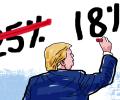
US President Donald Trump's announcement of 25 per cent tariff on all goods coming from India starting August 1, plus an unspecified penalty, is expected to impact Apple's plans to expand iPhone manufacturing in India as well as export of other electronics to the US. The move comes at a time when Indian electronics production is reeling under pressure due to restrictions imposed by China on supply of several critical components, capital goods and even skilled technology professionals.

India on Monday announced closure of negotiations for a free trade agreement signed with New Zealand, its 18th deal so far as the country aims to boost bilateral trade and investments. The India-New Zealand FTA is expected to be signed in the next three months and it is likely to come into force next year.

The market capitalisation of BSE-listed companies eroded by Rs 9,40,581.75 crore to Rs 4,50,61,658.60 crore (USD 4.90 trillion) in a single day.

A host of macroeconomic data announcements, global trends and trading activity of foreign investors would dictate investors' sentiment in the stock market this week, analysts said. Besides, auto sales data will be closely tracked, experts noted.

After two years of strong gains, smallcap stocks fell sharply in 2025, but the correction may be setting up opportunities for long-term investors.

Textiles, pharmaceuticals, chemicals, engineering goods, gems and jewellery exports will receive a boost from the free trade agreement between India and the 27-nation European Union, according to exporters.

Construction major L&T is gearing up to expand its footprint in the global nuclear supply chain, a senior company official has said, while calling for amendments to key legislations on the domestic front to pave the way for the entry of private players and foreign capital necessary for capacity enhancement.

FDI inflows into India are expected to register robust growth in 2026, supported by strong macroeconomic fundamentals, big-ticket investment announcements, sustained efforts to improve the ease of doing business, and a new generation of investment-linked trade pacts.

'Only four or five original companies remain; the rest have been replaced every decade as sectors evolve or leadership shifts.' 'Companies that fail to adapt -- like many textile mills from the 1970s and shipping firms from the 1980s -- disappear.' 'Benchmark indices reward those who reinvent themselves in line with economic demands.'

Defence Minister Rajnath Singh lauds the armed forces' restrained response during Operation Sindoor after the Pahalgam terror attack, highlighting coordination and improved connectivity in border areas.

The power sector presents a puzzle. A fast-growing economy should be aligned to higher power demand but that hasn't been the case in the financial year 2026 till date (FY26TD).

India's two-wheeler industry is seen growing 6-9% in 2026, though a proposed ABS mandate for sub-125cc models could push up prices and temper volumes.

The Indian services sector growth touched a ten-month high in June aided by robust expansion in international sales and job creation, amid positive demand trends and ongoing improvement in sales, a monthly survey said on Thursday. The seasonally adjusted HSBC India Services PMI Business Activity Index rose from 58.8 in May to 60.4 in June, driven by sharp upturn in new business orders.

Tata Group will create 5 lakh manufacturing jobs in the next five years across sectors such as semiconductor, electric vehicles, battery and related industries, its Chairman N Chandrasekaran said on Tuesday.

The Indian services sector growth touched an 11 month high in July, supported by a pickup in new exports orders and sharp rise in overall sales, a monthly survey said on Tuesday. The seasonally adjusted HSBC India Services PMI Business Activity Index was at 60.5 in July, little-changed from 60.4 in June, and the rate of expansion was the best seen since August 2024.

The government has identified critical sectors, including electronics, chemicals, leather and footwear, and toys, where value chains can be strengthened to facilitate and drive foreign direct investment (FDI) into the country. Invest India, the investment promotion and facilitating agency under the Department for Promotion of Industry and Internal Trade (DPIIT), has been actively identifying key value chains to focus on.

The private corporate sector showed improvements across various segments in the third quarter of the current financial year (Q3FY25), with the operating profit margin of listed non-financial companies increasing sequentially by 50 basis points (bps) to 16.2 per cent, according to the Reserve Bank of India (RBI) data released on Monday. Sales of listed private non-financial companies increased by 8.0 per cent during Q3FY25, compared to 5.5 per cent in the corresponding quarter a year ago. It was, however, 5.4 per cent in Q2FY25.

'Large firms and their interests can dominate the narrative, even as smaller stakeholders and retail investors struggle to be heard.' 'Regulators therefore require deep subject-matter expertise to assess representations, recognise underlying incentives, incorporate the perspectives of less-visible stakeholders, and guard against bias or capture,' notes Ananth Narayan.

The Indian economy recorded a six-quarter high growth of 8.2 per cent in July-September, as factories churned out more products in anticipation of a consumption boost from the GST rate cut, according to government data.

Companies are squeezing more profits from their operations relative to the capital they put to work, the highest now since 2011. Profit after tax relative to capital employed came in at 10.47 per cent in September, shows data from the Centre for Monitoring Indian Economy (CMIE), higher than the 8.41 per cent seen in September last year. This is the highest since March 2010.
